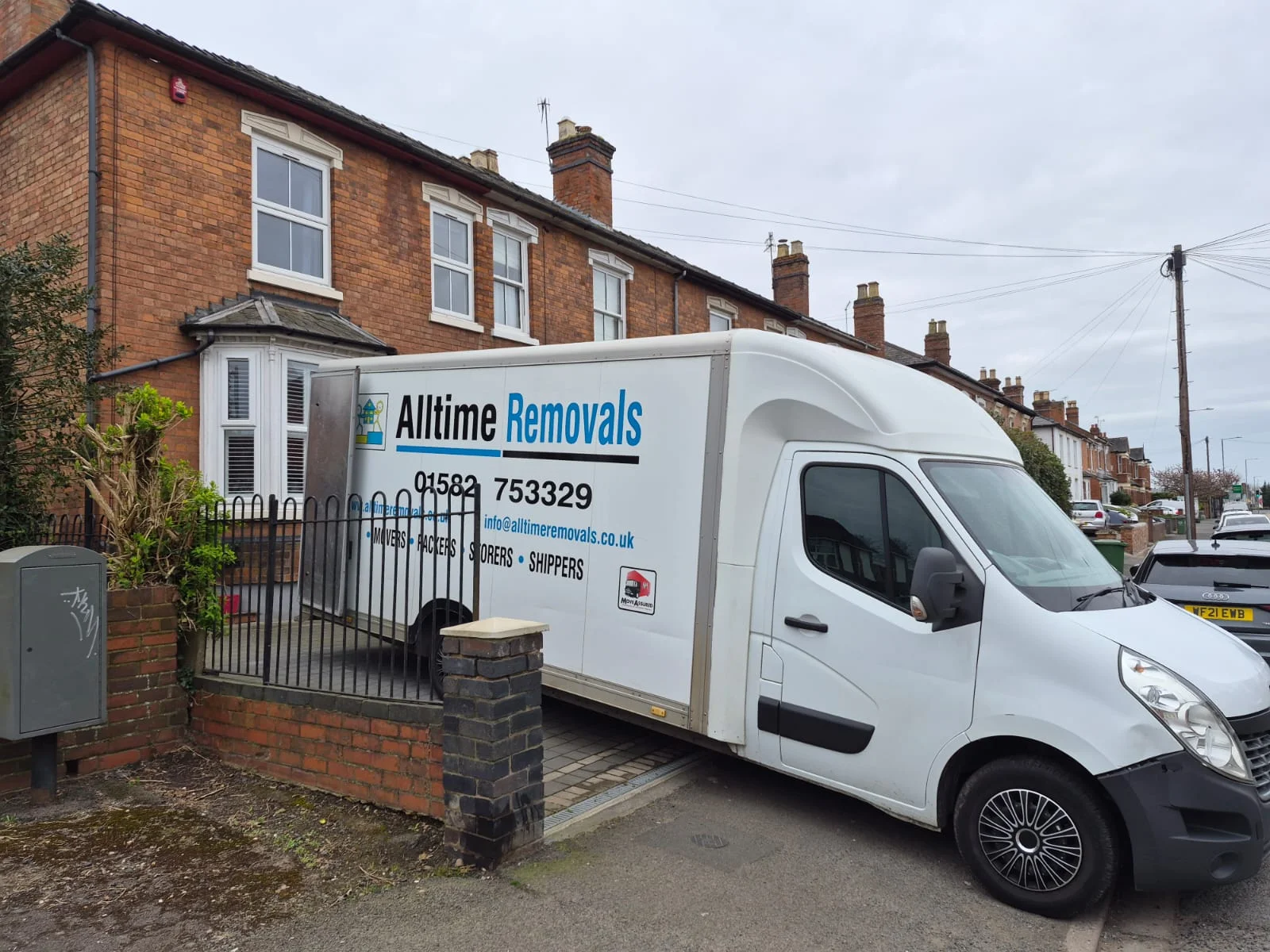
The honest answer is that no two moves cost the same. As a rough guide, independent guides such as the HomeOwners Alliance put the typical cost of a local three-bedroom house move in the UK at around £800 to £1,200, though the real figure depends on how much you are moving, how far, and how easy the access is at both ends. A one-bedroom flat in Houghton Regis costs far less than a four-bedroom detached in Luton moving to Bedford.
We are a Bedfordshire family firm based at Nimbus Park in Houghton Regis, trading since 2002 and accredited with AIM, MoveAssured and the RHA. This guide explains honestly what drives the price of a move, what the national averages actually say, and how to compare two quotes that look nothing alike, so you can work out a realistic budget before you enquire.
What does a removal company cost on average?
These are national averages from independent guides, not Alltime prices, and not a fixed price list. They give you a sense of the market before you get a proper quote. Costs rise sharply with distance and volume, and regional variation is large: one industry guide notes a three-bed move averaging under £700 in some areas and close to £2,000 in others.
| Move | Typical UK average (local) | Source |
|---|---|---|
| Studio or 1-bed | Lower end of the range | HomeOwners Alliance |
| 2 to 3-bed house | Around £800 to £1,200 | HomeOwners Alliance |
| 4-bed and larger | Upper end and above | HomeOwners Alliance |
| Long-distance moves | Add significantly for distance | HomeOwners Alliance |
Source: HomeOwners Alliance removals cost guide and MyJobQuote removals cost guide. These figures usually include the van, the crew and basic goods-in-transit insurance. Packing, materials, storage and furniture dismantling are normally quoted as extras.
The important point is that an average is not a quote. Your actual price depends on your property, which is why we give a fixed figure only after a free home survey rather than a number off a form.
What actually drives the price of your move
Understanding the variables lets you compare quotes properly instead of just picking the lowest number.
Volume. The single biggest factor. A full room-by-room inventory gives a far more accurate figure than a bedroom count. A three-bedroom house with one room full of home-office kit costs more than a lightly furnished one of the same size.
Access and carry distance. Older streets in Dunstable, Luton and Houghton Regis often have terraced rows where a large van cannot park directly outside. The further the crew has to carry, the longer the job. A parking suspension arranged with Central Bedfordshire Council a few working days ahead removes this. Newer estates with driveways load faster.
Floor level. A ground-floor flat is quicker than a third-floor flat with no lift. Upper floors and awkward staircases add crew time.
Packing. If the crew packs for you, that is extra labour and materials. If you pack yourself, the cost drops. More on whether that is worth it below.
Distance. Moves within the Dunstable, Houghton Regis, Leighton Buzzard and Luton corridor are shorter crew days than a move to London or further afield, where fuel and driver hours add up.
Day of the week and time of month. This matters more than most people realise, so it has its own section next.
What is the cheapest day to move?
Mid-week and mid-month are usually the quietest, and quieter days give you the best choice of crews and dates. The busiest slot in the calendar is the last Friday of the month, because most mortgage completions land at month-end and Fridays cluster around them. If your dates are flexible, a Tuesday, Wednesday or Thursday away from month-end is worth asking about. If you are tied to a completion date, book as early as you can, ideally four to six weeks ahead, so you are not left with the last slot available.
What will a removal company not take?
Every firm works to the same rules on what cannot travel in a removal van, and knowing this early avoids problems on the day. Removal companies generally cannot move:
- Flammable or hazardous materials such as paint, aerosols, gas canisters, petrol and cleaning chemicals
- Fuel in lawnmowers and petrol tools, which must be drained first
- Firearms, ammunition and controlled substances
- Perishable food
- Live plants in a closed van, particularly in summer
Cash, jewellery, passports, medication and irreplaceable documents should also travel with you in your own car rather than on the van. If you have items to clear before the move, our team can advise at the survey.
Is paying for packing worth it?
For many people, yes. Packing is the most time-consuming part of a move and the most common cause of breakages when it is rushed the night before. A professional packing service runs from a breakables-only option, where the crew handles the kitchen and fragile items and you do the rest, up to a full pack and unpack with material disposal.
It is worth paying for if you are short on time, moving a large home with a lot of glass and china, or juggling work and children around the move. If your budget is tight and you have time, packing yourself with proper materials keeps the cost down. The breakables-only option is the middle ground most families find best value, because it removes the riskiest part of the job for a fraction of a full pack.
Why a survey gives a firm price and an online estimate does not
An online estimate is a guess based on a bedroom count. It cannot see the loft that is full, the piano in the front room, the third-floor flat with no lift, or the narrow street where the van cannot park. That is why estimates so often change on moving day.
A home survey fixes that. An adviser visits your property, walks every room, notes the volume, the access at both ends and anything that needs dismantling, then produces a written quote you can hold us to. This is genuinely how we work. The survey is free, there is no obligation, and it is the only way to get a price that will not move on the day. If your move involves a gap between completion dates, we will also price storage into the same quote, so there are no surprises.
How to compare two removal quotes properly
Two quotes for the same job can look very different. Before deciding which is lower, check:
- Fixed or estimate? A fixed written quote commits the firm to the price. An estimate can rise. Ask which you are getting.
- What does the insurance cover? Goods-in-transit and public liability should be standard. If a quote does not mention insurance, ask before you sign.
- Packing included or separate? A low headline figure that excludes packing can end up dearer than a higher one that includes it.
- Did they survey the property? A quote from a photo or a bedroom count carries more risk of a change on the day than one from an adviser visit.
- What is the cancellation policy? Completion dates slip, so check how date changes are handled.
We do not claim to be the cheapest, and we would be cautious of any firm that does, because the lowest number often hides a rushed survey or thin insurance. What we offer is a clear, fixed, survey-led price.
Frequently Asked Questions
Independent guides such as the HomeOwners Alliance put the average local three-bedroom move at roughly £800 to £1,200, though the real figure depends on your volume, access and distance. A quote toward the higher end usually reflects a full loft, tricky parking, dismantling work, or a storage overlap. The only way to get an accurate figure for your home is a free survey and a written quote.
Mid-week and mid-month are generally quietest, so they give the best choice of crews and dates. The last Friday of the month is the busiest, because completions cluster there. If your date is flexible, avoid month-end Fridays. If it is fixed, book four to six weeks ahead to secure the slot you want.
Most UK domestic moves are priced by volume, the cubic footage your belongings take up in the van, rather than by weight. Long-distance and international moves sometimes factor in weight too. We price UK moves from a room-by-room inventory taken at the survey, so the figure reflects what is actually there.
A man and van costs less per hour and suits small loads, such as a single room or a studio flat. For a two-bedroom home or larger, the extra trips a small van needs often push the total above a proper removals crew with a correctly sized vehicle. Full removals firms also carry goods-in-transit insurance as standard, which a man and van may not.
A standard quote covers the crew, the van, fuel and goods-in-transit insurance. It may include protective covers and dismantling of standard flat-pack furniture. Packing, materials and storage are usually quoted separately. Ask for an itemised written quote so you can see exactly what is and is not covered.
Get a written quote for your Bedfordshire move
The best way to know what your move will cost is a free home survey. An adviser visits your property in the Dunstable, Houghton Regis, Dunstable or Luton area, walks every room, and returns a written figure you can hold us to.
Request a free home survey and written quote from Alltime Removals, a Bedfordshire family firm trading since 2002, accredited with AIM, MoveAssured and the RHA.